

Straight answers about drug rehab cost in Alaska, how long treatment takes, who pays for it, and what to do when someone you love won’t go.
The short version
Rehab can cost anywhere from nothing to tens of thousands of dollars, and most people do not pay the sticker price. Insurance, Medicaid, state-funded programs, the VA, and TRICARE all cover addiction treatment. If you are a Veteran or active-duty service member, there is a good chance you would pay little or nothing at all.
If you are reading this, some part of you is already thinking about getting help. Maybe for yourself. Maybe for someone you love. Either way, that counts for something.
And the questions you are probably asking are the practical ones. Can I afford this? How long will I be gone? Is it even worth it if the person doesn’t want to go? Those are exactly the questions people ask most when they search for drug rehab in Alaska. So we answered all six below, honestly, with links to the government sources so you do not have to take our word for it.
Quick note: this is general information, not medical or financial advice. Costs and coverage depend on your plan, your state, and what level of care you need. The fastest way to get a real number is to have someone check your benefits for you.
Free benefits check
We look up your TRICARE or TriWest coverage before you commit to anything.
No obligation
Ask your questions and hang up. Nothing happens until you decide.
Answered 24/7
Call at 3 a.m. if that is when you are ready. Someone will pick up.
If you need someone right now
Call or text 988, the 988 Suicide & Crisis Lifeline. Veterans and service members can dial 988, then press 1 for the Veterans Crisis Line, or text 838255. If someone has overdosed or is not breathing, call 911.
How Much Does a Drug Rehab Program Cost?
Short answer: It ranges from free at state-funded programs to tens of thousands of dollars for a month at a private residential program. What you actually pay depends mostly on your insurance and the level of care you need.
That range is huge, we know. It is huge because “rehab” covers a lot of different things. A weekly counseling group and a 24/7 residential program with medical staff are both called rehab. They do not cost the same.
Here is what drives the price up or down:
- Level of care. Living on-site with round-the-clock staff costs more than going home every night.
- Medical detox. Doctors and nurses watching you through withdrawal adds cost, and for some substances it is not optional. More on that below.
- Length of stay. 30 days costs less than 90. It also tends to work less well.
- Mental health care. Treating PTSD, depression, or anxiety alongside addiction takes more clinical time, but it is often what makes recovery stick.
- Your coverage. The biggest factor of all. Two people in the same program can pay wildly different amounts.
Here is a quick look at the main levels of care:
| Level of care | What it looks like | Relative cost | At Hope Valley? |
|---|---|---|---|
| Medical detox | Supervised withdrawal with medical staff, usually several days | High per day, short stay | Yes |
| Residential | You live on-site. Therapy, structure, and support every day | Highest overall | Yes, separate men’s and women’s homes |
| Partial hospitalization (PHP) | Full days of treatment, home or sober housing at night | Moderate to high | Coming soon |
| Intensive outpatient (IOP) | A few hours a day, a few days a week | Moderate | No |
| Outpatient | Regular counseling sessions, often weekly | Lowest | No |
One more thing worth knowing. Treatment is expensive, but addiction is more expensive. Lost jobs, legal trouble, ER visits, and damaged relationships all cost money too. The National Institute on Drug Abuse reports that every dollar spent on addiction treatment saves $4 to $7 in drug-related crime and criminal justice costs alone. Add in health care savings and the return is even bigger.
How Long Is Rehab for Drugs Usually?
Short answer: Most residential programs run 30, 60, or 90 days. Research points to about three months as the point where people see real, lasting results.
Thirty days became the “standard” mostly because that is what insurance used to pay for. It was never based on how long recovery actually takes.
The research says something different. According to NIDA, most people need at least three months in treatment to significantly cut back or stop using, and longer treatment tends to lead to better outcomes.
That does not mean you are locked in a building for three months. A typical path looks more like this:
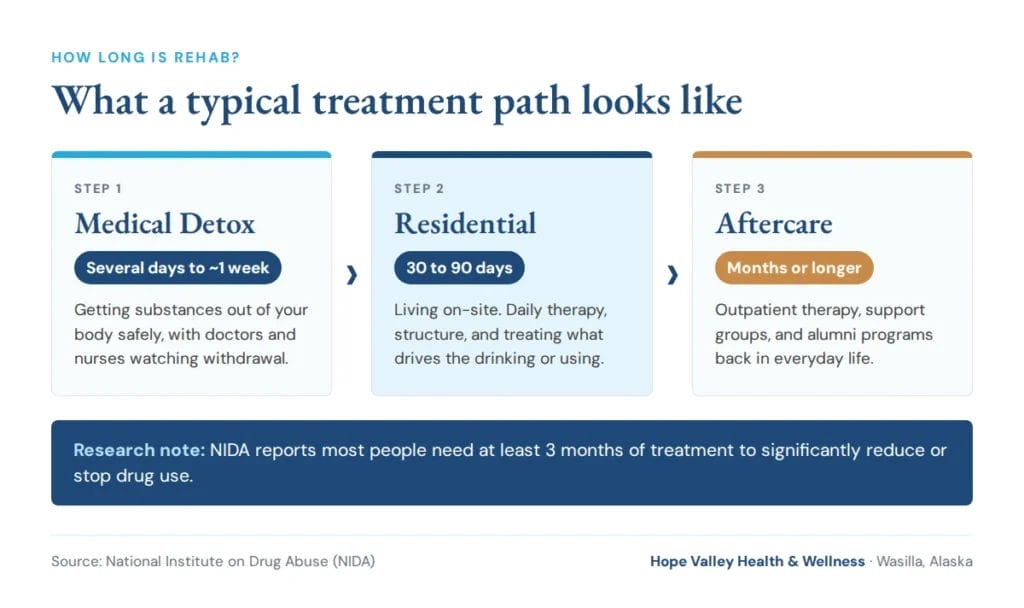
1. Detox: several days to about a week
Getting the substance out of your body safely, ideally in a medical detox program with doctors and nurses on hand. Some drugs, like benzodiazepines, need a slower taper that can take longer.
2. Residential treatment: 30 to 90 days
This is where the real work happens. Therapy, working through what drove the drinking or using, and building new habits.
3. Step-down care and aftercare: months, sometimes longer
Outpatient therapy, support groups, and alumni programs while you get back to normal life. Lower intensity, but it matters a lot.
The same timeline applies whether you are looking at alcohol rehab in Alaska or treatment for opioids, meth, or other drugs. We go deeper on this in 30 vs. 60 vs. 90-Day Rehab: How Long Does Treatment Take?
Do Addicts Have to Pay for Rehab?
Short answer: Not always. Most health insurance has to cover addiction treatment, and there are free and low-cost options for people without insurance.
First, a word about that word. A lot of people search “addict” because that is how they see themselves, or how they have been made to feel. Having a substance use disorder is a medical condition. It does not make you a bad person, and it does not mean you have to pay for treatment out of pocket.
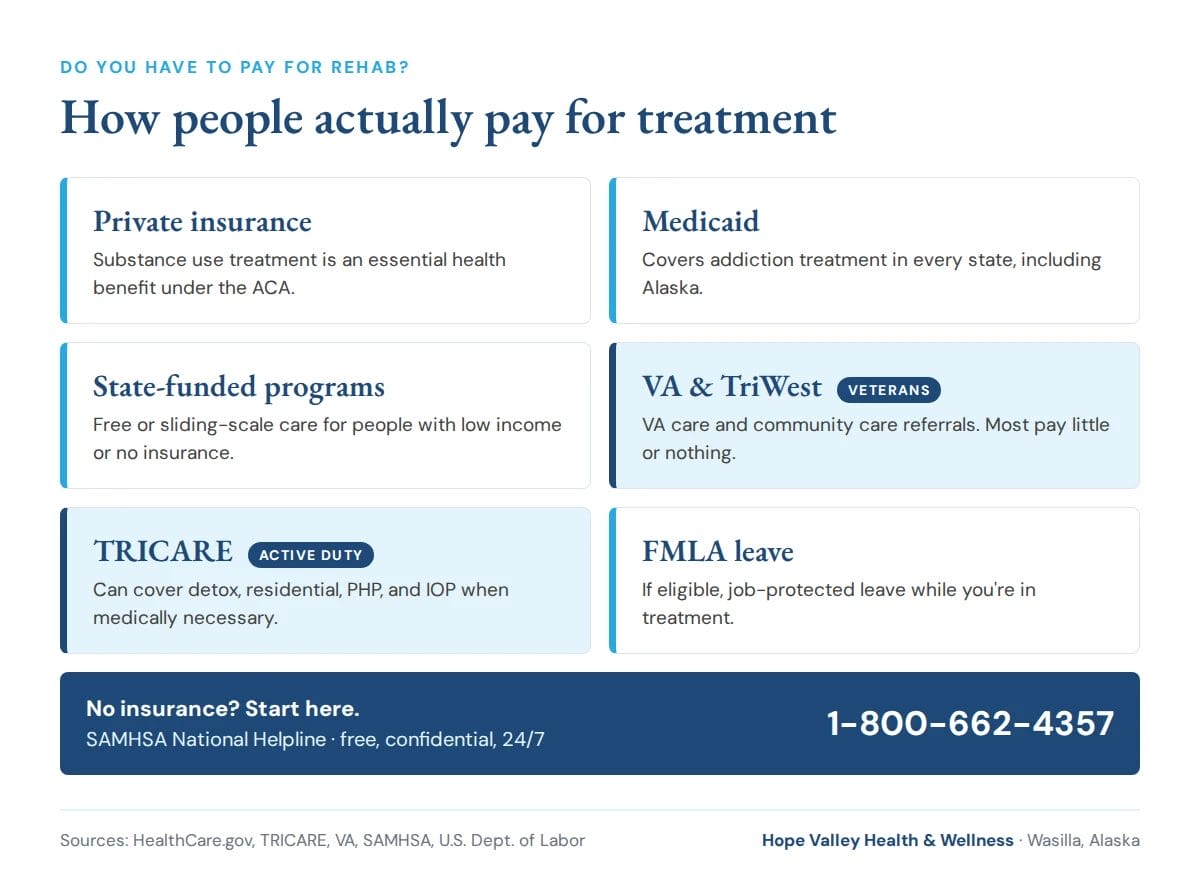
Here is who usually pays:
- Private insurance. Under the Affordable Care Act, mental health and substance use disorder services are an essential health benefit that Marketplace plans must cover. Federal parity law also says insurers generally can’t make addiction coverage harder to use than coverage for other medical care.
- Medicaid. Medicaid covers substance use treatment in every state, though what is covered varies.
- State-funded programs. Many states pay for treatment for people with low income or no insurance.
- The VA and TriWest. Veterans may be eligible for substance use treatment through the VA, including referrals to community programs through TriWest.
- TRICARE. TRICARE may cover detox, inpatient care, partial hospitalization, and intensive outpatient when it is medically necessary.
At Hope Valley, most Veterans come to us through a VA referral and typically pay nothing out of pocket. Active-duty service members using TRICARE usually pay little or nothing. You can verify your insurance here and we will tell you what is covered before you decide anything.
Want to know what you would actually pay?
Give us a call. We will check your TRICARE, TriWest, or VA benefits and give you a straight answer. No pressure, no commitment.
Confidential. Free. Answered 24/7.
How to Help an Addict That Doesn’t Want Help?
Short answer: You can’t force someone to want recovery, but you can make it more likely. Stay connected, stop cushioning the consequences, have calm conversations at the right moment, and take care of yourself too.
This is one of the hardest spots to be in. You can see exactly what is happening. They can’t, or won’t. And every conversation seems to end in a fight or a promise that doesn’t last.
The old idea was that you had to wait for someone to “hit rock bottom.” That is not true, and waiting can be dangerous. People who are pushed into treatment by family, work, or the courts often do as well as people who went on their own.
What actually helps:
- Pick your moment. Talk when they are sober and calm. The morning after a bad night can be a real opening.
- Talk about what you see, not who they are. “You missed work three times this month and I’m scared” lands better than “You’re a drunk.”
- Stop rescuing. Paying their bills or covering for them makes it easier to keep using. Read how to support recovery without enabling.
- Learn CRAFT. Community Reinforcement and Family Training is an evidence-based approach that teaches families how to encourage treatment without confrontation. It tends to work better than the surprise “TV intervention.”
- Have a plan ready. When they finally say “maybe,” you want a phone number and a bed, not a week of research. That window can close fast.
- Get support for yourself. Family groups like Al-Anon and Nar-Anon exist for a reason. You can’t pour from an empty cup.
SAMHSA’s family resources and NIDA’s guidance for family and friends are both good places to start.
If the person is a Veteran or service member
Military culture teaches people to push through, not ask for help. That makes this even harder. We wrote about why Veterans refuse help and what families can do, plus how to stage an intervention. You can also call us as a family member. We will talk you through your options, even if your Veteran isn’t ready yet.
How Do People Afford to Go to Rehab?
Short answer: Mostly through insurance, Medicaid, the VA, or state funding. Very few people pay the full price themselves.
If money is the thing stopping you, here is what to actually do, in order:
1. Let the treatment center check your benefits
Most programs will call your insurance for you, for free. It saves you hours on hold and you get a real number instead of a guess.
2. No insurance? Call the SAMHSA National Helpline
1-800-662-4357 is free, confidential, and open 24/7. They can point you to state-funded and sliding-scale programs near you.
3. Search FindTreatment.gov
FindTreatment.gov is the federal treatment locator. You can filter by payment type, including Medicaid, sliding scale, and free programs.
4. See if you qualify for Medicaid
If your income is low or you recently lost your job, you may qualify. You can check through HealthCare.gov or your state’s Medicaid office. In Alaska, Medicaid is run through the Alaska Department of Health.
5. Protect your job
If you are eligible, the Family and Medical Leave Act can let you take unpaid, job-protected leave for addiction treatment. Losing your paycheck and your job are two very different things.
For Veterans and active-duty members, the math is usually simpler. Between the VA, TriWest, and TRICARE, cost is rarely what keeps someone out of treatment. And if you are coming from the Lower 48, we arrange the travel to Alaska as part of admissions.
How Much Is 2 Weeks of Rehab?
Short answer: Roughly half the cost of a 30-day stay at the same program. But two weeks is usually enough for detox and a start, not a full recovery program.
We get why people ask this. Two weeks feels doable. You can maybe take the time off. You can maybe afford it. It feels less scary than a month or three.
Here is the honest part. In two weeks, most people get through detox and start to feel physically better. That is when the harder work begins: figuring out why you drink or use, dealing with the trauma, depression, or anxiety underneath it, and building a plan that holds up when you get home. Leaving right when you start feeling better is one of the most common setups for relapse.
If two weeks is truly all you can do, it is still far better than nothing. Just go in with a plan for what comes next, like outpatient care or support groups.
Please don’t try to save money by detoxing alone
Quitting alcohol or benzodiazepines suddenly can be dangerous. Severe alcohol withdrawal can cause seizures and delirium tremens, which can be life-threatening. Opioid withdrawal is rarely deadly by itself, but it is miserable enough that most people go back to using, and relapse after a break carries a high overdose risk. That is exactly why medical detox in Alaska and everywhere else is done under medical supervision.
What This Looks Like at Hope Valley
Hope Valley is a CARF-accredited drug and alcohol rehab in Wasilla, Alaska, built only for Veterans and active-duty service members. If that is you, here is what cost and time look like with us:
- Coverage: We accept TRICARE and TriWest and work with VA referrals. Most of our clients pay little or nothing out of pocket.
- Care: Medical detox followed by residential treatment, with dual diagnosis care for PTSD, depression, and anxiety.
- Setting: Small, separate homes for men and women, with no more than six residents per house.
- Travel: Coming from the Lower 48? We coordinate flights to Anchorage and the drive to Wasilla. Already in Alaska? We arrange travel from anywhere in the state, including rural communities you can only reach by air.
- Staff: Many of our team members are Veterans themselves. You will not have to explain military life to anyone.
Not a Veteran or service member? We are not the right fit, but you still have options. The SAMHSA Helpline at 1-800-662-4357 and FindTreatment.gov can help you find a program that is.
Frequently Asked Questions
Is rehab confidential?
Yes. Addiction treatment records have extra federal privacy protection under 42 CFR Part 2, on top of regular HIPAA rules. Treatment programs generally can’t share your information without your written consent, with limited exceptions like medical emergencies.
Does TRICARE cover rehab?
TRICARE may cover detox, inpatient and residential care, partial hospitalization, and intensive outpatient programs when they are medically necessary. Some services need a referral or pre-authorization. The easiest way to find out is to let the treatment center check for you. Verify your coverage here.
Will going to rehab end my military career?
Not usually, especially for a first-time alcohol problem where you came forward on your own. Drug use carries more risk. We break it all down in Will Going to Rehab End My Military Career?
Is 30 days of rehab enough?
For some people, 30 days is a solid start. But research shows longer treatment usually works better, and most people benefit from at least 90 days of care when you count step-down and outpatient treatment together.
What if I have been to rehab before and relapsed?
Then you are in very good company. Relapse is common with any chronic health condition, and addiction is no different. It doesn’t mean treatment failed or that you did. It usually means something needs adjusting, like a longer stay, a different level of care, or treating a mental health condition that was missed the first time.
Can I call just to ask questions?
Absolutely. Most of our calls start that way. You can call (907) 318-2180 any time, day or night, ask what you want to know, and hang up. No commitment.
Sources and Where to Get Help
Everything above is based on these official sources. We recommend checking them directly.
Crisis and confidential support
- 988 Suicide & Crisis Lifeline: call or text 988
- Veterans Crisis Line: dial 988 then press 1, or text 838255
- SAMHSA National Helpline: 1-800-662-4357, free and 24/7
Finding and paying for treatment
- FindTreatment.gov: federal treatment locator
- HealthCare.gov: mental health and substance use coverage
- TRICARE: substance use disorder treatment coverage
- VA.gov: substance use treatment for Veterans
- U.S. Department of Labor: Family and Medical Leave Act
Research and family guidance
- NIDA: Principles of Drug Addiction Treatment
- SAMHSA: resources for families
- MedlinePlus: alcohol withdrawal
- eCFR: 42 CFR Part 2, confidentiality of treatment records
You don’t have to have it all figured out
You don’t need to know what you can afford, how long you’ll stay, or whether you’re “bad enough.” That is what the first call is for. We will check your benefits, answer your questions, and tell you honestly if we are the right fit.
Confidential. No obligation. Answered 24/7. Or send us a message.